Unexpected in October

Recent recording of a piece I first posted a year ago.

Unexpected in October – recorded reprise – Eulogy for Scott

If I can make a landscape for a dream, let it be this place. Some day soon the winter will fall, but this afternoon in this garden the sky is still clear and brazen blue, the wind still rustles in the leaves not yet turned and birds chatter on in deep greenery, insects still flutter in dappled shade. The sun still warms my face, the grass still growing under my feet, a squirrel climbs to the highest waving branches where glossy green ivy leaves entwine, waiting for the year to pass on. I close my eyes, a tranquil moment for the dead and dying, held in trance-like waiting, the sun still calls my eyes to the sky. I don’t want to lose this moment, I don’t want to go indoors, but the chill air rising creeps up my spine, a flying crow caws overhead, the wonder is breaking, broken by a growling jet that cuts the sky in two. Some day soon the winter will fall again, but now, today, this afternoon in this garden, summer still lingers on, and hope is still strong. If I can make a landscape for a dream, let it be this place.

Cat Anna

From “the Wall of Girls” series

1.Black Annis

Also called Black Annis
Image by Jenny Clarke
taken from the cover of
Leicestershire Legends retold by Black Annis (Bob Trubshaw ISBN 978 1872 883 779)

Deep in the Dane Hills area of Leicester there is said to be a dark dank cave inhabited by a terrifying woman-creature known as Cat Anna. Her skin is blue, her hair is matted unkempt fur, her fingernails are blood-blacken claws, her tongue long long and sandpaper rough, she is naked apart from a girdle made of babies-skulls.

They say that Cat Anna has her own underground tunnel running from her cave-lair right into the compound of the Leicester Castle, a building of ancient repute. It is not known if Richard III ever walked this tunnel, but I could resist the opportunity to band-wagon-jump the latest Leicester-related tourism-myth.

I have heard tell that there is a certain gatehouse in the Castle wall, that to this very day children refuse to pass through after dark. A place where youth tremble, weep and withdraw, calling out piteously the name Cat Anna.

According to the local folklore Cat Anna lives in a deep dank cave at the foot of the Dane Hills, rehearsing ambush tactics in her head. In her lair she is peaceful contemplating dinner. Her long blackened fingernail-claws click-clack and she thinks again about dinner.

It is said that the trees around the entrance to Cat Anna’s lair are adorned with the empty skins of dead children. Her victims slain, sucked dry, their skins discarded, like dirty linen, strung out to dry out on the death-trees thereabouts.

Children have told me that Cat Anna drops on her victims from the vaulting in the gatehouse arch, like a ginormous bat, enveloping her dinner in her boney  black membranous batwing arms. Scuttling back through the tunnel with boys-bones a-crunching, Cat Anna lurks in the shadows of her lair and devours. She sucks out the very essence, from wobbling guts to slithery bone marrow. Then she flings away their skins, which catch on the up-thrown branches of the yearning yew-trees ranged around the entrance, to dry in the sun, like pork-scratchings, or parchment.

Leicestershire Legends retold by Black Annis

Throwback Tuesday Payback

Meandering through the content on my website I came across this article, it seems to be the oldest blog posting on the site. The book review was written in august 2011, under my old pseudonym Jean Dark, the novel itself was published in 2010. I remember the book well, it was a joy to read and a joy to review. please enjoy…

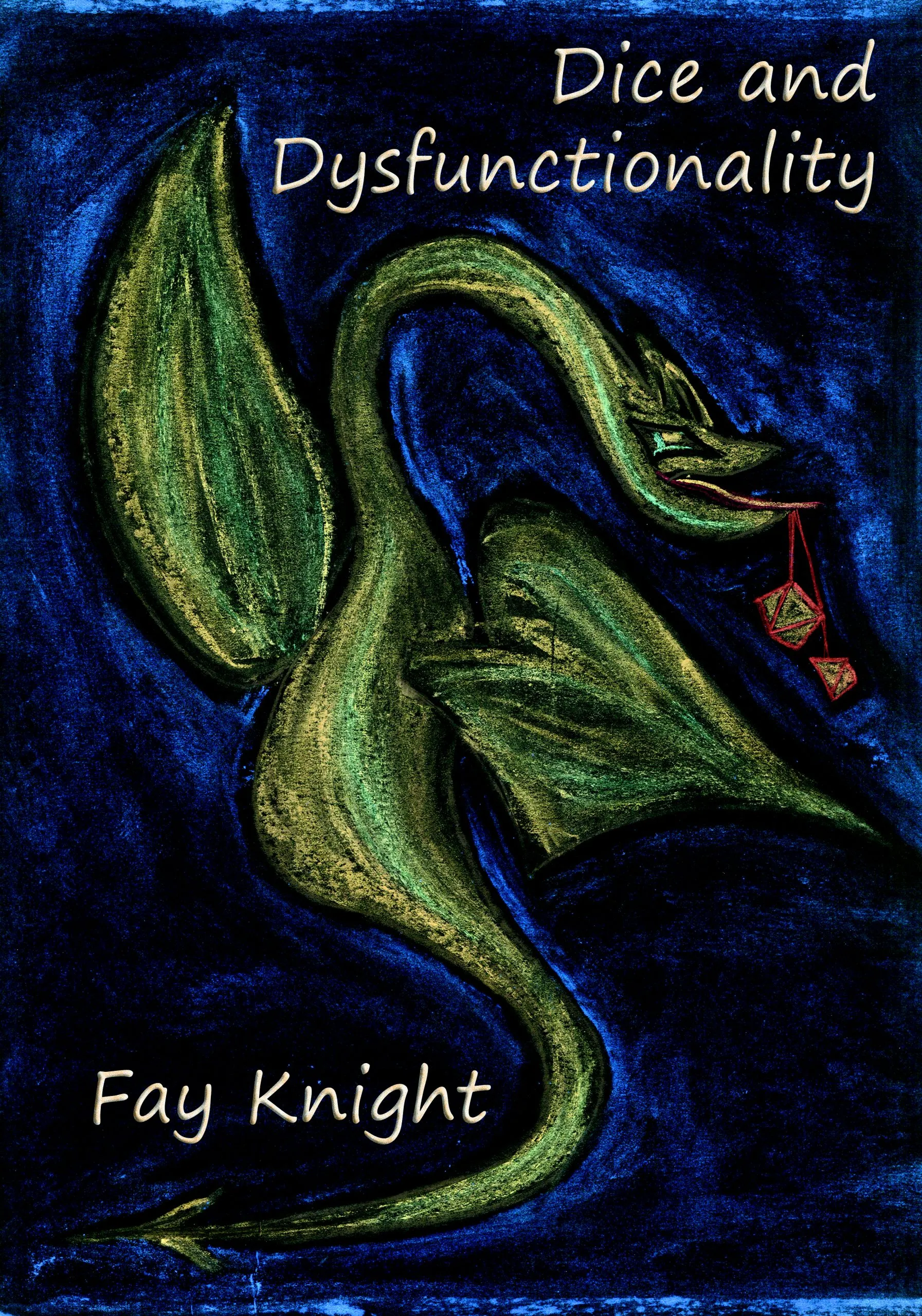
Dice & Dysfunctionality by Fay Knight

Published 2010 by Shield Crest Publications

The Role-Player/Pagan crossover is a well known phenomena (See Ann Finnin’s The Forge of Tubal Cain for a real life example) and this debut novel by Fay Knight mines that rich seam with surrealism, dark humour and panache.

The wonderful opening line “Kevin already knew he was going to die” immediately catapults us into the skewed world of the “Dice-Tossers”, as one long-suffering girlfriend describes them.

From there the rapid-fire plot loops and swirls and sweeps unrelentingly through all manner of strange shenanigans; UFOs, swoopy bat-like things lurking in the dark, goth clubs, a lost weekend in Whitby, an Old Dear packing a pistol fired up with the vision of a local tele-evangelist as the anti-christ.

And there’s dragon-porn too. A collection of hand drawn images which “go a bit further than Giger’s artwork” become empowered and manifested by an unspecified and possibly accidental Austin Osman Spare Zos-Kia style sex magic ritual. Knight’s writing leaves everything to the imagination and my mind kept flinging up lurid images from vintage science fantasy paperback covers. Not to mention more terrifying dragon-on-dragon variants.

The book is seamlessly written, and the dialogue is particularly witty and sharp-tongued. Characters seem to emerge progressively, realistically as well-rounded, but not always sympathetic, individuals from the initial homogeneity of a role-player clique. At least, some of them do, one or two remain repellently unfathomable, shady strange secretive huddled and whispering in the corner.

This is an enjoyable read for anyone with an interest in paganism or gaming, you’ll recognise many of the characters among your friends. It would also be an ideal yule gift for any sigil-wielding, dragon-loving dice-tossers you may know.

Better still, give a copy to their girlfriend, who’ll undoubtedly snigger knowingly.

Jean Dark

Edgewords 3 is here!

Join us for our launch event tomorrow at The Edge Cafe at 7pm (doors open 6:30pm), where the contributors will be sharing their wild encounters. Entry is free. Copies of Edgewords £5 (all proceeds to The Edge Cafe, for its work supporting people in recovery from addiction).

The Worm of Haftvad

Last weekend I had a wonderful time at a storytelling event at Buckden Towers. A group of us stayed all weekend sharing tales from the Shahnameh, a Persian text by 10th century poet Abolqasem Ferdowsi. The schedule organised by Marion Leeper was wall to wall storytelling, it was pretty intense but rewarding and enjoyable with long breaks to chat, make new friends and eat loads of food, biscuits, cake and pudding.

Here is the script of the tale I related.

Haftvad and The Worm

The tale I am about to tell reputedly happened during the reign of King Ardeshir almost 1800 years ago, and it was related to Fedowsi in the tenth century by a travelling snake-oil salesman.

High atop a precipitous mountain, somewhere in modern Iran there still stands a glorious citadel built in mud. It has become known to us as Arg-e-Bam – the castle that exploded.

It’s turrets gaze out over the surrounding country, a magnificent mountain castle keep of unparalleled splendour, it is still the world’s largest adobe building, more extensive and breath-taking than the ancient mud ziggurats of Ethiopia.

But who built this opulent fort? we ask ourselves, which munificent princeling created this enduring wonder? – the answer is nobody knows, his name has not come down to us through history, it has been buried in the shifting sands of time. Arg-e-bam was founded by a man with no name.

But I am getting ahead of myself, at the beginning of the story there is no mountaintop citadel, there is only the modest town of Karajan.
That distant town nestled in a rich fertile valley crescent, cupped between the shore of a clear glassy  lake. And  the abundant forest foothills of a craggy, scree-riven  mountain. Karajan, A small dead-end of hard-working tranquillity.
This small moth-eaten town at the far end of a minor tributary path that meanders on into a circuitous ancient route that leads on to the laden caravans and the astonishing marvel of the ancient Silk Road. (gong)
In the  town of Karajan – that scraped a paltry existence through the crafts of spinning and weaving –  there once lived a man with seven sons who the Shahnameh tells us was called Haftvad. Now the strangest thing about Haftvad was that he had no name, Haftvad simply means “The Man with Seven Sons”.

So, Haftvad had no name and neither did his sons. But the strangest thing is that Haftvad also had a daughter, and he took no notice of her. He took notice of his singular beautiful daughter, the most important person in this story. Haftvad’s daughter, who also has no name. Haftvad’s only daughter,  his one daughter, his first, his number one, his prima. And because I think she deserves better than to be nameless, I shall call her Alif, like the first letter of the  alphabet.

The people of Karajan lived in a state bordering on poverty. And like his neighbours, Haftvad made a living in the town, a small living, more than just surviving, but not much more.  It was a poor but cheerful town.

The people worked hard, carding and spinning and weaving the most exquisite fabrics.  Even the children worked hard. The boys spent their nights high in the mountains with their herds, or days in the fields tending fibrous crops. And each day, from early in the morning the girls, the unmarried maids of the town, tramped out into the hillsides, with their heavy distaffs and their bales of wool, and they  spent their day on the hillside, spinning, not returning until nightfall, laden with skeins of yarn. These were poor resourceful girls who were able to spin most anything into thread of some kind. They could spin cotton, linen, stinging nettles, hemp, , they would spin sheeps wool, goats wool, rabbits wool and when they could get it – they would spin the finest, beautifulest, most sought after yarn of all, from the wool of a worm.

girls spinning illustration from Ferdowsi’s Shahnameh

The thread the girls spun was taken down into the town at nightfall and stored to be weaved into long bolts of fine cloth by the rest of the townsfolk.

Like most of the girls and women of the town, Alif’s dark sleek corkscrew hair was twisted and coiled up with a beautiful woven headscarf, she looked very fine. Indeed, all the girls and women dressed well, they were poor, but lived in a town where off-cuts and remnants of luxurious cloth were bountiful. All the maidens of the town were impeccably dressed, and wanted only jewels and shoes to be mistaken for princesses. They lived the opulent lives of a rag man’s daughter.

This rhythm of life persisted through time, unchanging and consistent until one strange day when Alif found a worm.

That day started the same as any other fine autumn day. The girls gathered at sunrise and made their way through the fall trees, their leaves tipping orange. They found a clearing in a mulberry grove and spun with laughter and gossip and hard work. At lunchtime they sat in a circle and chatted over their food together.

Fedowsi tells us –
It was just  at that moment Haftvad’s daughter found
A windfall apple lying on the ground
And picked it up – now listen carefully
Because this story’s quite extraordinary:
She bit the apple then, but as she tried it
She saw a little worm there coiled inside it:

Well now, we’re all familiar with the story of the maiden, the snake and the apple, and I can almost hear you calling out: “No! No! Don’t eat the apple! Don’t eat the apple!”.
But have no fear, this story is about Alif, not Eve, it’s not about a priviledged trustafarian snowflake cupped in the palm of gated-community paradise. This story is about Alif a practical down to earth girl, a lowly spinster living in a threadbare textile town, somewhere south of the Silk Road.
So Alif restrained herself, looking at the maggot in the mulberry apple,

She scooped it out and gently found a place
For this small worm inside her spindlecase.
And as she took up her cotton she said
“By God I swear, today I’ll spin such thread,
Helped by this apple’s lucky worm, that you
Will be amazed at what I can do!”
The girls began to laugh – in their delight,
There faces glowed, there teeth shone silver-white”

Which just goes to show that although they were poor they could still afford toothpaste.

Well, come sunset that day, the girls gathered up their spindles and counted the skeins of yarn they had spun. And true to her prediction, Alif had spun much more than she usually did. The other girls were agog at Alif’s productivity. “That truly is a magic worm!” they exclaimed “You should take good care of it” “it is a blessing” Alif agreed as she marked the amount on the ground then ran like wind-bourne smoke to show her mother how much she had completed. From that day on Alif fed the worm each morning and kept it safe in a box under her bed. Alif said to herself “I am going to spin so much thread, by the grace of this worm, that I’ll never be poor again”.

– And so, Alif fed the worm everyday
And the worm increased in size day by day
Alif’s spun more and more thread by the week
Her father grew richer and richer every month

Alif looked at the growing worm and admired it’s smooth sleek scaled black skin. And here’s the strange thing she noticed about the Worm – it had a tiny weeny wincey mouth and the hugest fat stomach you have ever seen.  So it could eat only the smallest of morsels, but could never eat enough to fill it’s big empty belly. And Alif wondered for moment if the Worm was a metaphor for greed, but then she stopped herself because she was a down to earth parochial girl and the fancy Chinese concept of a hungry ghost was beyond her comfort zone.

Every morning Alif fed the worm a piece of the apple, and however much cotton there was, Alif magically spun it into thread.

The image of the girl miraculously spinning preternatural amounts of yarn often appears in European fairy tales. And generally the girl is tricked by some disguised evil magician so that her only escape from forever spinning is to solve a riddle by guessing a name, or hand over a newborn child or kiss an ugly reptile. Not so in this story because  – the Worm, like almost everybody in this story, has no name to guess, Alif has no first born son to sacrifice, and although she’s poor, she’s not about to go snogging with a maggot, however beautiful it’s black and orange crackly skin. Alif has standards.

So, in the story of Haftvad and the worm there seems there is no quest, no riddle or tribute to pay. The magic worm gave Alif the ability to spin monumental amounts of thread and asked nothing in return beyond it’s basic needs of food and shelter. And over time Alif’s prodigious output is such that her family are no longer able to keep up, they need to employ people, more and more people, to help weave the copious thread into cloth…

After a time Alif’s father began to notice her and wonder at her miraculous skill, the source of his burgeoning wealth and he questioned her. “You spin so much that it seems that you’ve taken a fairy for a sister”.

Alif laughed because she knew there were no fairies in this tale. “it’s from the apple and the little worm inside it” she said, then she showed Haftvad the miraculous worm and explained everything to him.

At this point the story totally changes direction,  and Alif simply disappears from the narrative, it truly now becomes the story of Haftvad and the Worm. Because at this moment, Alif’s father – Haftvad –  instantly took control of the situation. Haftvad assigned assistants to care for the worm and he used his new found wealth to build a castle keep on the nearby mountaintop for the Worm to live in. And as Haftvad’s wealth grew he assigned courtiers and soldiers to attend the worm and he extended the castle keep into a grand Fort, where the worm was indulged, safe secure and comfortable. The Worm continued to grow. As Haftvad’s wealth grew he incorporated a magnificent citadel around the fort on the mountaintop. And Haftvad assigned Viziers and Generals to serve the giant worm. Although in truth the Generals and Viziers franchised out the day to day care of the worm to some dodgy private security firm. Haftvad realised that his continued wealth was dependant on the whims of the worm and he did all he could to appease it, keep it safe and keep the money rolling in.

And the town prospered, and the women and girls of Karajan were soon able to afford the jewellery and the shoes to make them the very simulacra of princesses.

Alif, of course, kept on spinning, she was the goose that laid the golden egg, endowed with the blessing that turned to a curse. Like Ariadne she had to spin for her life.

And as this is no fairy tale, it is as it always is in real life Haftvad’s conspicuous wealth and power attracted the attention and envy of malcontents, thieves and kings. At first Haftvad easily suppressed these attacks by the grace of the magic worm, and through a combination of largesse, cowardice and the brute force of his seven sons – each of which commanded an army of 10,000 soldiers a piece. Haftvad grew in power.

Alif spun on as was her destiny, the eternal spinster silhouetted, momentarily glimpsed through the dim light of history.

Haftvad’s fortress citadel became so well-known that they say even the winds of heaven didn’t dare blow around it.

Twice King Ardeshir himself rode  against Haftvad and twice the King was trounced.

Defeated, the King and his armies returned home. The Worm’s reputation went before him. Skirmishes broke out but as soon as the soldiers heard of the tale of the almighty worm they lost heart and fled. So it was that finally, Ardeshir resorted to underhand methods, he devised a cunning plan to kill the Worm itself and break it’s spell. And so in the end the Worm was brought down through a combination of trickery, flattery  and ill-conceived drinking games with the worm’s guards.

As the Citadel trembled and shook from the explosive death throes of the Worm, King Ardeshir pronounced from the ramparts of Haftvad’s vanquished citadel “I fed the worm molten lead; his power is gone.” Hadvad and his sons were executed and their names were erased from history.

High atop a precipitous mountain, somewhere in modern Iran there still stands a glorious citadel built in mud. It has become known to us as Arg-e-Bam – the castle that exploded.

It’s turrets gaze out over the surrounding country, a magnificent mountain castle keep of unparalleled splendour, it is still the world’s largest adobe building, more extensive and breath-taking than the ancient mud ziggurats of Ethiopia.
Submissions for Edgewords Renewal Anthology

The deadline for Edgewords Renewal Anthology draws closer, next week in fact, so please do get your finger out and send us your wonderful SHORT fictions and poems. There is a word limit of 300 words or 30 lines – details are on the Edge Cafe website – here.

The new anthology is edited by Munizha Ahmad-Cooke, Lisa Evans and Jean Dark. We have had several very wonderful submissions already, and the 19th September deadline is now looming. We are still waiting for you to send us YOUR contribution.

We recently recorded Munizha’s beautiful piece -Ripe – which appeared in the first Edgewords Anthology, you can listen to our reading of it here.  It was recorded a few week ago at Lisa’s, in the home studio she shares with her partner Colin. So many thanks to Colin for making the recording, we had such a lovely afternoon!

Follow this link to send your submissions to us – Edgewords Renewal Anthology

The Edgeworders. by Victor Manuel-Ibanez for Oblique Arts. 2017.

The Edgeworders. by Victor Manuel-Ibanez for Oblique Arts. 2017.

The first Edgewords Anthology was published last year, and came about through a series of Creative Writing workshops during September and October 2017. We were lucky to have the support of Oblique Arts, The Edge Cafe and Cambridge City Council who made the project possible.

Here is a photograph of the writing group by Victor. I think we look like a rock band! In fact, we are pausing during a workshop, at The Mayan Pyramid near Snakey Path on a writing expedition to Cherry Hinton Hall.


Edgewords Renewal Anthology Submission Form

Archive

Flash Fiction

Skull Collection

Jean Dark

Psychogeography 

Home page

Esoterranean Books

Follow Bella Basura on:
Facebook
Twitter
tumblr
Youtube

We Wrote, And Wrote, And Wrote

Here, for your pleasure,  is the report I wrote for The Edge Cafe Newsletter April 2018 about the Creative Writing group at The Edge Cafe…

On 12th January this year a thronging crowd gathered at The Edge Café for the combined Launch of Edgewords Anthology and Oblique Arts Exhibition.

Edgewords Launch 12th January 2018 The Edge Cafe cambridge

Edgewords Launch 12th January 2018 The Edge Cafe cambridge

As I stood beside the Community Fridge, I wondered how many more people could comfortably fit into the room. In nervous anticipation I watched, as more chairs were dragged out from the back room to seat the expanding, buzzing audience. Victor, Munizha, Lisa, Faith, Kate and I (The Edgeworders) were waiting to perform from Edgewords Anthology chapbook. Chapbook is a sixteenth century term for an independently printed pamphlet. In making our 2018 chapbook we participated in the whole process of it’s production: from writing content, through editing and collating, proof-reading and printing, to bookbinding paperback and hardback copies, using traditional hand binding methods.

We started writing back in September last year, our Creative Writing sessions ran on Friday afternoons, and we spent two hours a week in word games, outings to Cherry Hinton Hall and a local bookshop. We played with images, rune cards and even a chess board to ignite our imaginations. Our writing was posted weekly on our blog-page (https://oblique-arts.com/tag/creative-writing-workshops/). We chatted, drank tea, laughed and got to know each other, but mostly we took quiet time to explore, follow and write out our thoughts and inspiration, we wrote, and wrote, and wrote.

By November we had gathered enough material to edit our chapbook, which we then proof-read, printed and bound. Later, preparing for the Launch, Edgeworders worked together at solo performance and in devising collaborative group performances.

Edgeworders at The Maya Pyramid at Cherry Hinton - by Victor-Manuel Ibanez

Edgeworders at The Maya Pyramid at Cherry Hinton – by Victor-Manuel Ibanez

The accompanying Art Exhibition, in deep white frames around the walls, encompassed a range of media – photography, painting, sketching, illustration, bookbinding and collage, work from Oblique Arts visual art workshops in December and January.

For me, the Launch was a thoroughly enjoyable success, and a satisfying culmination of working with inspired and inspiring writers. I hope we can secure funding for future creative writing sessions, and produce an Edgewords 2 Anthology.

I am hoping we Edgeworders will meet again soon
for yet more Wild Encounters.see footnote

Thanks to Bev, Sarah and Jannie of Oblique Arts, Andy and The Edge Café staff, Simon and ASH Coop, and to Cambridge City Council. I mostly want to thank Munizha, Lisa, Victor, Faith, Kate, Jane and all who joined us in the Creative Writing workshops, for the enthusiasm and joy they brought to the project.

Footnote: Wild Encounter is a delicious ruby-red fruit tea served at The Edge Café.

Edgewords Launch running order:
Introductions from Beverley Carpenter, Jannie Brightman and Jean Dark.
Performing Haikus Medley – Group Collaboration Performance.
Mill Road Day by Victor-Manuel Ibaῆez.
Speaking of Smoking by Bella Basura.
Recovery Runes by Faith.
Fiction by Munizha Ahmad-Cooke.
BREAK.
Rainy Hearthfire by Jean Dark.
Gaia by Faith.
The Narrow Escape by Victor-Manuel Ibaῆez.
Ripe by Munizha Ahmad-Cooke (performed with Lisa Evans and Jean Dark).
The Cuckoo by Lisa Evans (Group Collaboration Performance)


Jean Dark
Spring 2018

Clutches of Love

Spent today working on my next solo chapbook – Clutches of Love – due out early  February…

Here is a Boxing Day taster to whet your appetite.

Lost Again By Dave Challis March 2017

At the looking glass rotunda
In the centre of the city
I swear
I saw you
Sidling sharpish
Invisible-like
Under billows
Of covering smoke
I swear
I saw you
Slipping off sideways
Thin through the mirror’s edge
Disappearing from sight


Recorded version


Clutches of Love

The Skull Collection

Archive

Psychogeography

Jean Dark

The Short Answer Chapbook

Clutches of Love

By Dave Challis March 2017Clutches of Love is a new chapbook of my flash fiction that I am preparing for early next year, I thought I’d give you a taster with this brand new story below

Go Suck Lemons!
You sit there with the spilling pint tippling, dribbling down your trouser leg, and slurring you moan “Oh poor me. My life is so terrible. So traumatic. I’m so destroyed”. I pity you, so say something reassuring, something cheering, a glass half-full in the early afternoon, some everyday shaft of sunlight through the dust in the gloom of an unloved room.
You slam your half-empty beer on the bar and snarl personal insults at me, digging deep for intimate confidences, laying bare my private nightmares to the glare of the public bar, “And you don’t no nuffink” growled. I want to cry, your mates laugh, you plough on with this character assassination monologue.
Until I say “Go suck lemons!” and walk away.
And you shrink back , like a slug from a flame, and slurring you moan “Oh poor me. My life is so terrible. So traumatic. I’m so destroyed”.

Bella Basura December 2017

Back to Clutches of Love

The Skull Collection

Archive

Psychogeography

Jean Dark

The Short Answer Chapbook for sale here